
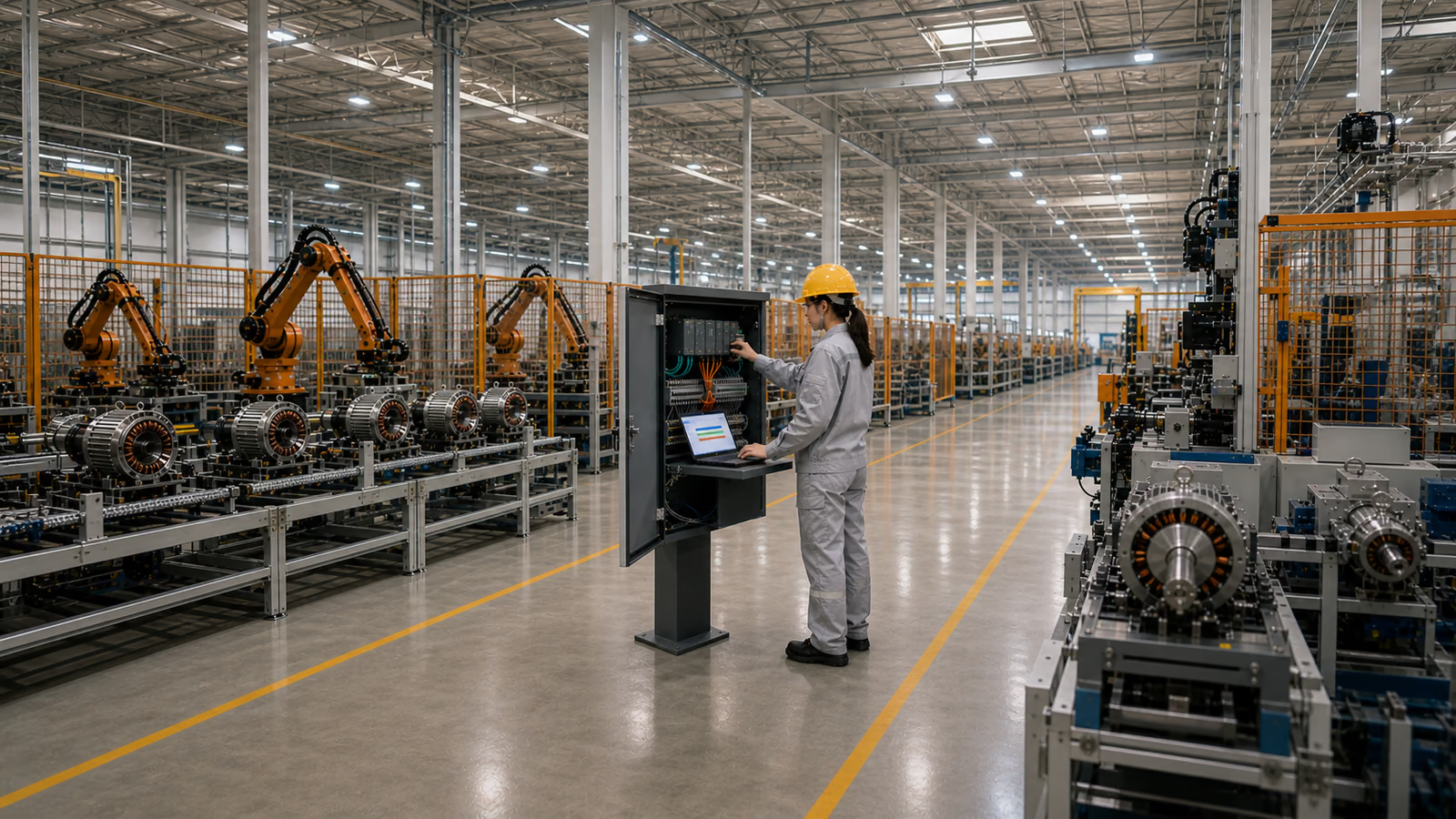
What is production cybersecurity and OT protection?
After a plant assessment, the company should have an up-to-date map of IT/OT connections, a list of supplier remote-access paths, risk owners, recovery-test results and approved maintenance windows. Maintenance teams and management can then assess progress without experimenting on a live production line.
IT and OT operating experience
We combine IT administration with protection of production networks, backups and privileged accounts, scheduling changes around plant operations.
Business project delivery
A plant assessment plan should connect networking, continuity, segmentation and risk reporting. IT/OT scope, participation of plant operations, required competence and test limits are agreed before engagement.
Direct consultation
We define the initial scope from critical production lines, IT/OT connections, supplier remote access and continuity requirements. The discussion identifies the information needed to assess plant risk.
How to manage a manufacturing company to avoid hacker attacks?
IT covers business information systems; operational technology (OT) controls physical industrial processes. A production plant connects IT, OT, suppliers and legacy systems. Compromised access, control or data can affect people, the environment, product quality and process continuity. Assess these risks with OT engineers and process owners, including remote maintenance, network dependencies and recovery.
- Identify critical production processes and the systems that maintain their availability.
- Separate IT risks from OT risks, but manage them in one register and with one business owner.
- Check whether remote service access, VPN, shared accounts and legacy systems are not the simplest path of attack.
- Determine which data and systems are strategic for production, sales, logistics and technical documentation.
The most important risks in production
Manufacturing is prone to incidents because it connects office systems, industrial networks, suppliers, integrations, legacy systems and pressures on business continuity.
- Encryption of file shares, ERP systems, technical documentation or operator stations.
- Unauthorised service access via VPN, remote desktops, shared accounts or no MFA.
- No segmentation between office, production, guest and administrative networks.
- Legacy systems that cannot be easily updated but still support critical processes.
- Backup without a recovery test, so the recovery time after the incident is unknown.
Recommendations for changes to company IT systems
Changes to production systems require access controls, network segmentation, monitoring and agreement with process owners. Zero trust means that network access alone does not establish trust: identity, permissions and access conditions must be checked. Outdated systems, supplier accounts without multifactor authentication (MFA), missing logs and untested backups can enable attacks or impede recovery.
- Introduce zero trust mechanisms for administrators, suppliers, VPNs and critical systems.
- Centralise visibility of events from firewall, EDR, servers, Microsoft 365, OT systems and infrastructure monitoring.
- Standardise updates, change tests, and maintenance windows to improve security without stopping production.
- Organise backup, retention, RTO/RPO and recovery tests for production systems, not only office ones.
- Document security exceptions and assign them an owner, review date, and compensating controls.
A practical decision map for the production and IT director
Not every risk requires immediate system replacement. It is important to separate quick security measures from projects that require testing, a service window, and approval from the process owner.
Remote access and MFA
Provider, VPN, administration, and remote service accounts should have MFA, time limits, and logging.
Segmentation and firewall
IT, OT and guest networks should be separated by rules, monitoring and the principle of least privilege.
Monitoring and response
Alerts must have an owner, priority, escalation threshold and after-hours action procedure.
Managing production to reduce hacker attack risk
Attacks on accounts, networks and production systems can disrupt orders, logistics, production or documentation access. Select safeguards according to process dependencies, failure impact and technical constraints. OT changes require agreement with process owners, maintenance and system vendors.
- Start with a process and dependency map to know where an attack will stop production the fastest.
- Reduce the attack surface through MFA, segmentation, shutting down unnecessary services, and controlling privileged accounts.
- Monitor critical systems and establish alarm thresholds that trigger response procedures.
- Test updates and security tools within a controlled scope before they hit production systems.
- Report risk in business language: potential downtime, cost, owner, deadline and reduction plan.
Phased action plan for the production plant
Address urgent risks from the outset with OT engineers, process owners and equipment suppliers. Changes must respect human and process safety, testing and approved maintenance windows. The following 30/60/90-day reviews assess progress; they do not defer baseline protection.
- 30-day review: confirm dependencies, owners, remote access, critical backups and urgent actions.
- 60-day review: assess approved MFA and segmentation controls, access restrictions and recovery-test results.
- 90-day review: assess monitoring, response exercises, legacy-system risk and the modernisation plan.
- Periodically and after material changes: review recovery, exceptions, safe-shutdown procedures and documentation.
How to reduce risk without stopping production
Assess effects on human and process safety, involve OT engineers and follow vendor guidance. Test updates, agents and active scanning away from the live production line first. Then approve scope, the maintenance window, rollback and safe-return criteria.
- Document flows and dependencies first, then change network rules or configurations.
- Separate administrative accounts from user accounts and limit vendor access to specific resources.
- Verify device compatibility and test updates and agents in an isolated, representative environment before approved deployment.
- Establish the recovery time objective (RTO) and the maximum acceptable period of data loss (RPO) for production systems, not just email and office files.
- Establish an approved safe-shutdown or alternative-operation procedure; do not bypass interlocks or safety functions.
Related Virtline services
Production security requires a combination of audit, security implementation, backup and maintenance. A single provider can shorten the time from diagnosis to action by taking responsibility for setup and evidence.
Cybersecurity
Risk diagnosis, policies, segmentation, remote access, monitoring and incident response.
Backup and data recovery
Backups, recovery testing and disaster recovery planning for outages or ransomware affecting critical systems.
IT outsourcing
Continuous maintenance, administration, updates, documentation and reporting for the corporate environment.
Agreeing external IT support for production
Not every manufacturing company has an internal security team that can simultaneously manage the network, servers, backup, endpoints, monitoring and audit documentation. Often, the responsibility falls on the director of operations, production or an administrator who lacks the capacity to run a full security programme. Professional IT outsourcing allows you to delegate some of the administration and supervision to specialists, but it should include specific evidence: updates, configurations, reports, backup tests, access reviews and risk recommendations.
IT outsourcing
Constant administration, helpdesk, documentation, monitoring and reports for the production environment.
IT network administration
Segmentation, firewall, VPN, policy reviews and infrastructure access control.
IT helpdesk
Handling support requests, escalating incidents and communicating with users and process owners.
Contact
We review IT/OT dependencies, remote access, backup, segmentation and response procedures before changes put production continuity at risk.







































