
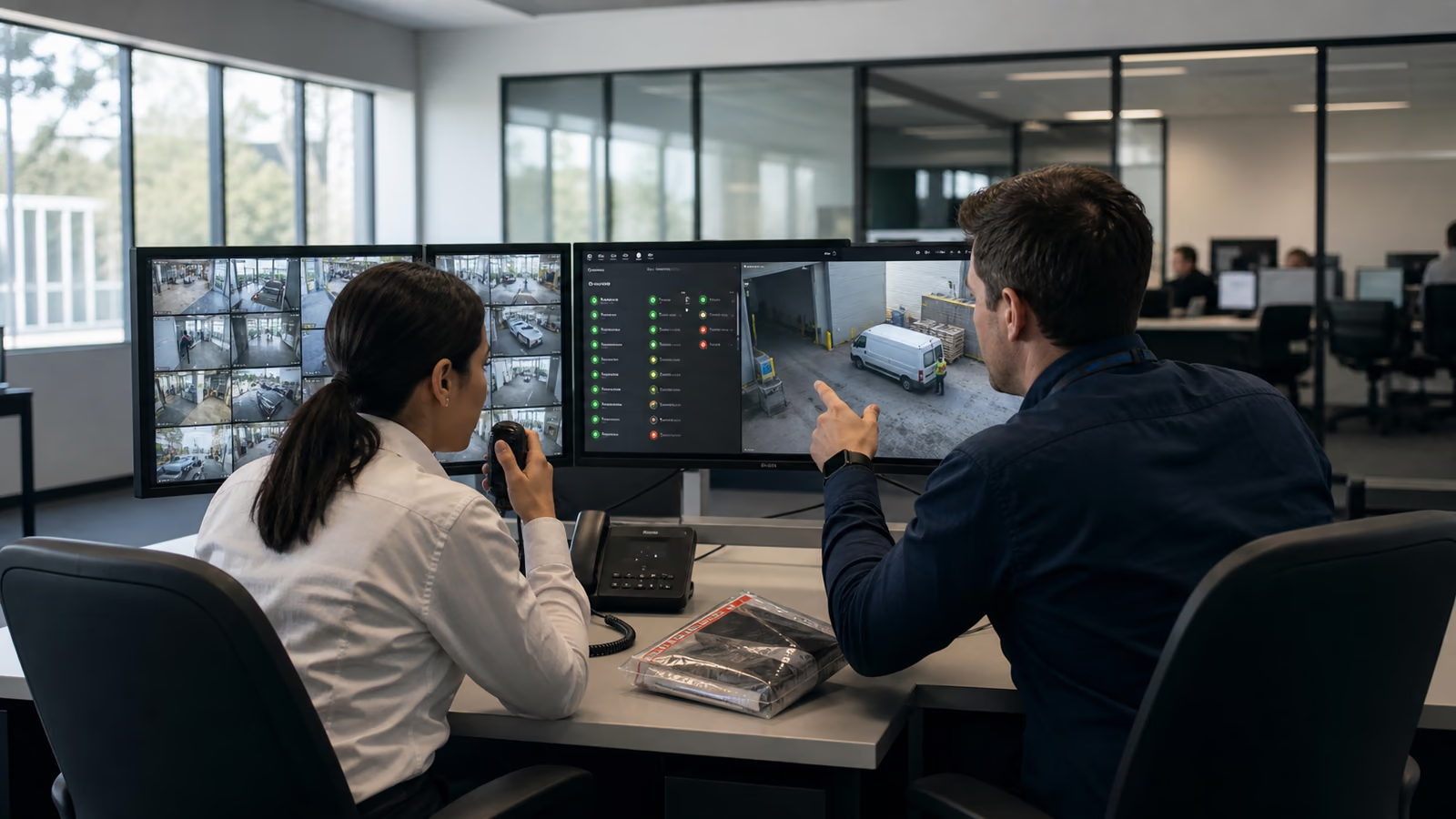
One governance model for two monitoring domains
IT monitoring measures service availability, performance, capacity and dependencies. Video surveillance (CCTV) covers cameras, network video recorders (NVR), recording continuity and access to footage. The technologies remain separate but can share alert reporting, ownership and response procedures. Set thresholds, retention periods and permissions separately for each system.
Define each scope separately, then connect ownership and escalation
Scope should follow business impact. Infrastructure components and CCTV assets need separate inventories, but their owners, dependencies, critical hours, notification channels and escalation rules must fit one response process.
- Business services, servers, storage, databases, network devices and critical links.
- Backup, capacity, certificates, scheduled jobs and parameters required by RTO and RPO.
- Privileged accounts, security events and components that require rapid escalation.
- Cameras, NVR, disk health, power, connectivity and retention when CCTV is included.
- Service owners, dependencies, critical hours and agreed notification channels.
Technical, operational and management dashboards
A single view cannot serve every audience or merge unlike data. Technical dashboards retain domain-specific metrics, while operational and management views connect alerts to impact, ownership, response status and decisions.
Technical view
Shows metrics, logs, dependencies, thresholds and the context administrators need for diagnosis.
Operational view
Orders alerts by impact, owner, response time and restoration status.
Management view
Presents risk, trends, availability, recurring causes and decisions that require budget.
How to interpret warnings and alerts correctly
Infrastructure thresholds and CCTV/NVR alarms are configured differently, but colour and priority are useful only when they trigger an action agreed in advance.
- Green means a verified state within expectations. Missing or stale telemetry is an unknown state that needs its own signal, not confirmation of health.
- Amber indicates growing risk, such as low space, a delayed backup or declining performance.
- Red means impact on a service, data or users and requires a runbook-led response.
- Every critical alarm needs an owner, response target and escalation path.
- Automated response needs limits, logs, error handling and a manual stop option.
Runbooks: from notification to a safe response
A runbook is a step-by-step instruction for responding to an alert. It defines actions, authority and contacts so the response does not depend on one person’s memory.
- What to check in the first minutes and which evidence to collect before making changes.
- How to determine impact on users, data, security and business continuity.
- Which actions may run automatically and which require approval.
- Whom to notify, when to escalate and how to hand responsibility to the next shift.
- How to close the event, record the root cause and update the threshold or instruction.
Roles, on-call coverage and escalation
Monitoring becomes a service only when the organisation knows who receives the signal and who makes the decision.
- The business owner defines service criticality and acceptable downtime.
- The administrator diagnoses the technical cause and acts within assigned authority.
- The helpdesk records user impact, communicates status and checks ticket completeness.
- On-call coverage and escalation address events outside business hours, backup and critical systems.
Data quality, thresholds and alert-fatigue control
Thresholds that are too sensitive create noise; thresholds that are too broad delay fault detection. Parameters must be tuned against real load and event history.
- Enable essential critical alarms before launch using risk and vendor limits. Then collect baselines and seasonality and tune thresholds; do not defer fault detection until observation is complete.
- Distinguish missing telemetry from an actual failure of the monitored component.
- Group dependent alerts so that one cause does not produce dozens of tickets.
- Review false positives, alerts without action and events detected too late.
- Change thresholds through a controlled process with history and rollback.
Integration with documentation, tickets and compliance requirements
An alert should enter one handling process, retain the decision trail and point to related documentation.
- Create a ticket automatically with priority, owner and technical context.
- Link it to the CMDB, service map, emergency instruction and change history.
- Record detection, acknowledgement, action start and service-restoration timestamps.
- Retain logs and reports in line with audit, contractual and internal requirements.
How infrastructure monitoring, CCTV, SIEM, EDR and helpdesk fit together
Each tool has a distinct technical role. The shared layer is the response process: business context, priority, owner, ticket, escalation, evidence and closure. Clear boundaries prevent duplicate alerts and accountability gaps. Monitoring works best when integrated with infrastructure operations, networking, cybersecurity and data protection.
Infrastructure and CCTV/NVR monitoring
Measures service availability, performance, capacity and jobs while separately confirming camera reachability, recording continuity, disk health, retention and controlled access to footage.
SIEM and EDR
Correlate security events and support threat detection and response.
Helpdesk and operations
Connect the technical signal to user impact, communication and a complete ticket.
Computer networks
Segmentation, stable connectivity and secure access to devices.
Cybersecurity
Control of accounts, updates, logs and incident response.
Backup and data recovery
Verification of copies, retention and recovery readiness.
How to measure monitoring effectiveness
Measures should show response speed, signal quality and whether the underlying cause was removed sustainably.
- MTTD and MTTA: mean time to detect an event and mean time to acknowledge its alert.
- MTTR: agree the definition of mean service-restoration time, the measurement start and end, and how users confirm restoration.
- Share of false positives, unowned alerts and recurring events.
- Number of issues detected before users, data availability or CCTV recording continuity were affected.
- Completion of corrective actions arising from reports and root-cause analysis.
Evidence that should remain after implementation
The project must leave more than working charts; it needs material that enables audit, maintenance and safe change.
- Register of monitored services, owners, dependencies, thresholds and priorities.
- Runbooks for backup, capacity, service failure, suspicious logins, camera loss, NVR faults and recording gaps.
- First-month report covering alerts, response times, noise and recommendations.
- A risk-prioritised action plan for capacity, patching, segmentation, on-call cover and automation; urgent risks do not wait for a routine review date.
- History of notification, escalation and recovery tests plus approved changes.
How management should evaluate monitoring
Management reporting translates technical data into risk, resilience and investment decisions.
- Which services are critical and whether they have an owner, runbook and required RTO/RPO.
- Which events stopped work or could have led to data loss.
- How availability, capacity, incident volume and restoration time are changing.
- Which causes recur despite action and require modernisation or process change.
- Which decisions, budget and deadlines are needed in the next governance cycle.
Handover to internal teams
Operational acceptance must prove that the team can handle an alert without help from the configuration author.
- The service and dependency map is current and available to on-call staff.
- Access to dashboards, tools and documentation is granted by role.
- Verify that test alarms reach the correct channels and create the expected tickets.
- Runbooks are exercised with administrators, helpdesk and service owners.
- The handover record names the maintenance owner, review rhythm and change rules.
Cost control and the order in which systems are monitored
Not everything needs to be monitored at once. Priority should follow impact and the organisation’s ability to respond.
- Start with critical services, backup, links, capacity and single points of failure.
- Do not collect metrics that nobody can or should act upon.
- Compare monitoring and on-call cost with downtime, data-loss and manual-diagnosis cost.
- Expand in waves after alert quality and owner readiness have been confirmed.
Maintaining monitoring after changes
Assign owners, enable critical alarms, prepare response procedures and test escalation before production launch. Update thresholds and dependencies after changes. Set review frequency from risk; ownership changes and critical vulnerabilities need prompt action.
- Every material change should include monitoring and documentation updates.
- After deployment, test the alert, escalation and reporting chain.
- Review noise, inactive data sources and unused dashboards monthly.
- Confirm owners, criticality, RTO/RPO and on-call scope quarterly.
- Before launch: confirm IT and CCTV scope, alert channels, owners and response to faults or missing telemetry.
- After launch: measure baselines, reduce noise, test procedures and update documentation without disabling necessary alarms.
- During operation: review trends and response outcomes, cautiously automate proven actions and confirm ownership after changes.
CCTV/NVR controls within the shared operating model
CCTV is an IT-connected system that processes personal data and has its own accounts and network dependencies. Its design should combine NVR architecture, segmentation, power, roles, retention, configuration backups and maintenance with data-protection safeguards. Each mistake below increases failure or unauthorised-access risk. Video monitoring should not be an isolated technical island.
- Before deployment, the controller documents the specific monitoring purpose and appropriate lawful basis for each area and intended use of footage.
- Where employees are monitored in Poland, the scope must also be checked against Article 22² of the Polish Labour Code, including its closed list of purposes, employee-information and signage duties, and special conditions for restricted rooms.
- Necessity and proportionality are assessed through field of view, operating hours, retention and whether a less intrusive measure could achieve the purpose. Audio, biometric processing and advanced analytics need a separate, cautious assessment and should not be treated as default CCTV features.
- Before go-live, prepare signs, accessible information and procedures for data-subject rights. A DPIA is mandatory, among other cases, for systematic monitoring on a large scale of a publicly accessible area under GDPR Article 35(3)(c); otherwise assess the need from the nature, scope, context and risk of the processing.
No segmentation
Cameras and NVR on a flat network facilitate lateral movement and weaken access control.
Ad-hoc remote access
Public services, shared accounts and missing MFA undermine accountability and response.
No maintenance process
Old firmware, a full disk or an untested export may surface only after an incident.
Acceptance criteria for the shared monitoring model
Acceptance should test realistic infrastructure and CCTV/NVR events independently, then prove that each follows the agreed chain from detection through ownership and escalation to evidence-backed closure.
- A failure or threshold test creates an alert with the correct priority.
- The notification reaches the owner and escalation starts within the agreed time.
- Dashboard, ticket and report show the same status and timestamp.
- For CCTV, image quality, retention, roles, export and playback are confirmed.
- Documentation, configuration backups, runbooks and the accountability record are complete.







































